
1. Charging pile meaning, characteristics and classification
The main feature of AC charging piles for electric vehicles is strong fault tolerance, but high resolution, which is a small range of cameras. According to the number of charging and discharging interfaces, it can be divided into single-pile charging and discharging and multi-pile charging and discharging.
Moreover, the electric cabinet covers an area of less than 0.5 square meters, and is easy to install and place. It is suitable for installation in urban villages, garden communities, industrial parks, and other open spaces. And the installation location can be changed at any time. It is pointed out that the current market environment of new energy charging pile is not mature and various operation modes of new energy vehicle charging pile coexist, thus it is difficult to achieve unified development. Therefore, it is unreasonable to diversify the charging methods.
The charging station shall systematically manage the battery. The scale of the piling market continues to expand every year, stimulating batch after batch of players to enter the game to "rush for gold". According to different charging methods, electric vehicle charging piles can be divided into DC charging piles (bolts), AC charging piles (bolts), and AC-DC integrated charging piles (bolts).
In the new energy vehicle charging pile parking space management method, the number of new energy vehicle charging piles is increasing, but it is still difficult for electric vehicle owners to find new energy vehicle charging piles to charge. This is because the management of charging pile parking spaces is not yet in place and fuel vehicles still occupy the parking spaces of new energy electric vehicle charging piles.
Charging and improving charger performance are key to management. What are advantages of the electric vehicle charging pile? How many electric vehicle charging piles? Fast and environmentally friendly electric vehicles have been favored by the public since their birth, but the difficulty of charging has plagued the "electric vehicle owners".
2. Charging pile meaning and main components
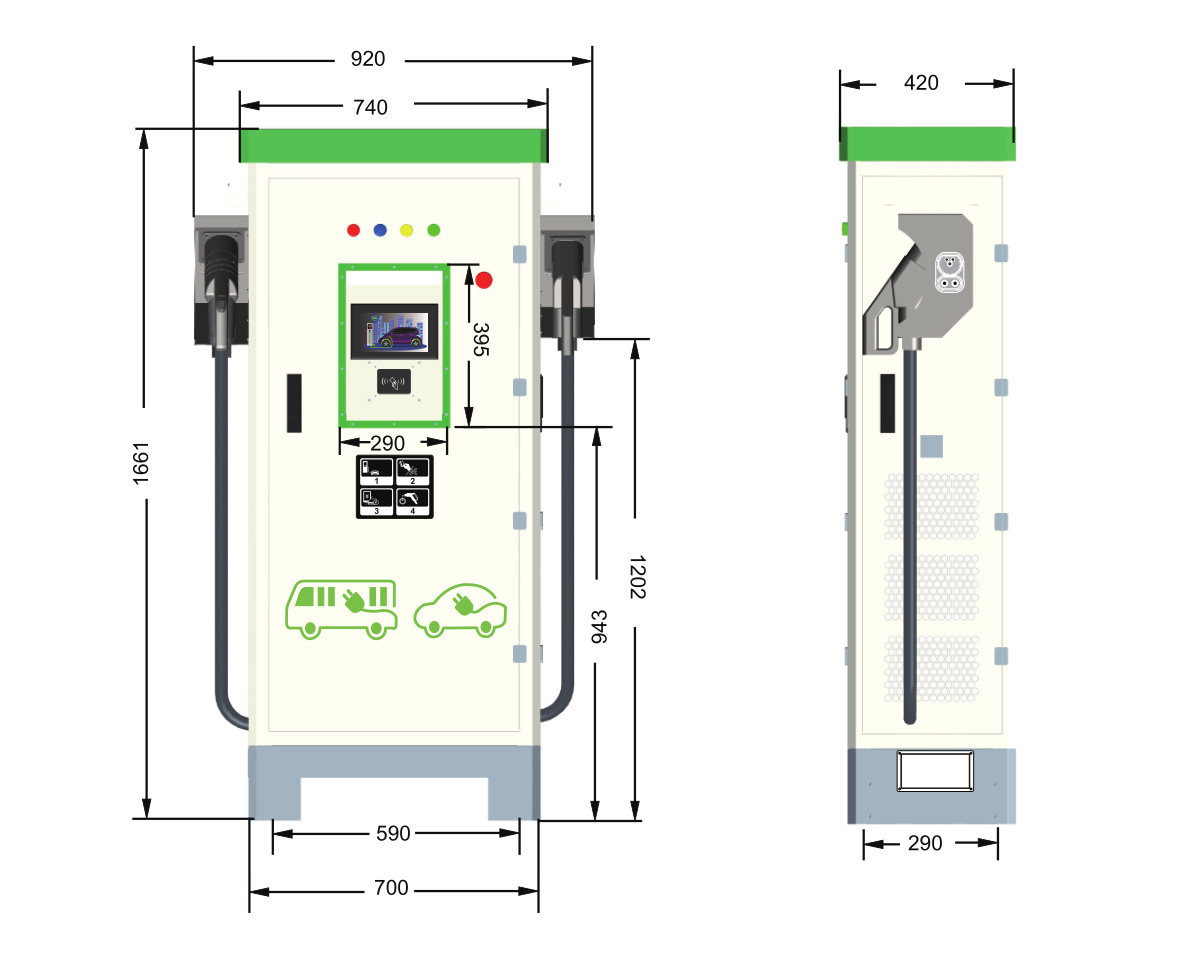
A charging pile is a fixed electric vehicle charging device that supplies controlled electrical power to an EV through a charging cable and connector. It may be installed on the ground or a wall and used in residential parking areas, workplaces, commercial sites, or public charging locations. Depending on the equipment design, a charging pile can provide AC charging through the vehicle’s onboard charger or DC charging through an external power-conversion system.
An EV charging pile typically includes a power conversion or control module, electrical protection devices, an energy-metering unit, a communication module, a user interface, and an electric vehicle charging pile cable with a compatible connector. These components regulate charging output, monitor operating conditions, record energy use, and communicate with the vehicle. The exact configuration varies between AC, DC, and integrated AC/DC charging piles.
Charging companies also need to increase the research and development of fast charging technology, and create a higher charging speed on the premise of ensuring that the battery life is not lost or shortened, so as to create their own barriers. The role of the electric vehicle charging pile is similar to that of the refueling device inside the gas station. It can be fixed on the ground or wall, installed in public buildings (public buildings, shopping malls, public parking lots, etc.) and residential parking lots or charging stations, and charge various types of electric vehicles according to different voltage levels.
Some traditional charging sheds are installed by companies that charge more for users of traditional charging sheds in order to make a profit. Because the power of the electric vehicle charging motor is generally small, the AC charging pile realizes fast charging, so the AC charging pile is also called slow charging.
The input end of the ev charging pile is directly connected to the AC power grid, and the output end is equipped with a charging plug to charge the electric vehicle. To restore battery capacity to 100%, some overcharge reaction must be allowed.